
When Is a Heart Transplant the Only Option? Signs You Need to See a Specialist
For someone living with heart failure, everyday life can change in small, easy-to-miss steps. Climbing a flight of stairs feels harder. A short walk leaves you breathless. Ankles swell by evening. Most people manage this with medication, lifestyle adjustments, and regular check-ups, and it works well for years.
For a smaller group of patients, heart failure keeps progressing despite good treatment, and families start asking a difficult question: is a heart transplant the only option left? The honest answer depends on the individual and is decided only after detailed specialist assessment. This article explains what advanced heart failure looks like, which signs deserve medical attention, and how doctors decide whether transplantation should even be considered.
When Is a Heart Transplant Considered?
A heart transplant is considered only when the heart’s pumping function has declined so severely that other treatments can no longer provide adequate quality of life or safety, confirmed through detailed specialist evaluation rather than a single symptom or test.
Doctors generally think about transplantation in the context of advanced, or end-stage, heart failure, where the heart muscle has weakened to a point where it struggles to pump enough blood to meet the body’s needs, even with medication.
A few situations that may prompt this discussion include severe symptoms persisting despite appropriate medical therapy, significantly reduced pumping capacity, repeated hospital admissions for worsening heart failure, and progressive deterioration despite correct treatment. In some cases, advanced heart-failure therapies that were previously helpful stop providing sufficient support.
None of these factors alone determines eligibility. A specialist looks at the complete clinical picture before transplantation is even raised as a possibility.
Signs You May Need to See a Heart Transplant Specialist
Certain warning signs suggest heart failure may be progressing and specialist review is worthwhile, though they do not by themselves mean a transplant is needed.
These include increasing breathlessness, particularly with minimal activity or at rest, and fatigue that feels persistent rather than occasional. Everyday tasks such as dressing or climbing a few stairs may become noticeably harder. Other signs worth discussing with a doctor include:
- Recurrent swelling in the legs, ankles or abdomen from fluid retention
- Repeated hospital admissions for heart failure within a short period
- Symptoms worsening despite taking prescribed medication correctly
- A reduced ability to exercise compared with before
- Dizziness, fainting or unusually low blood pressure, in the right context
- A general, ongoing decline in day-to-day functioning
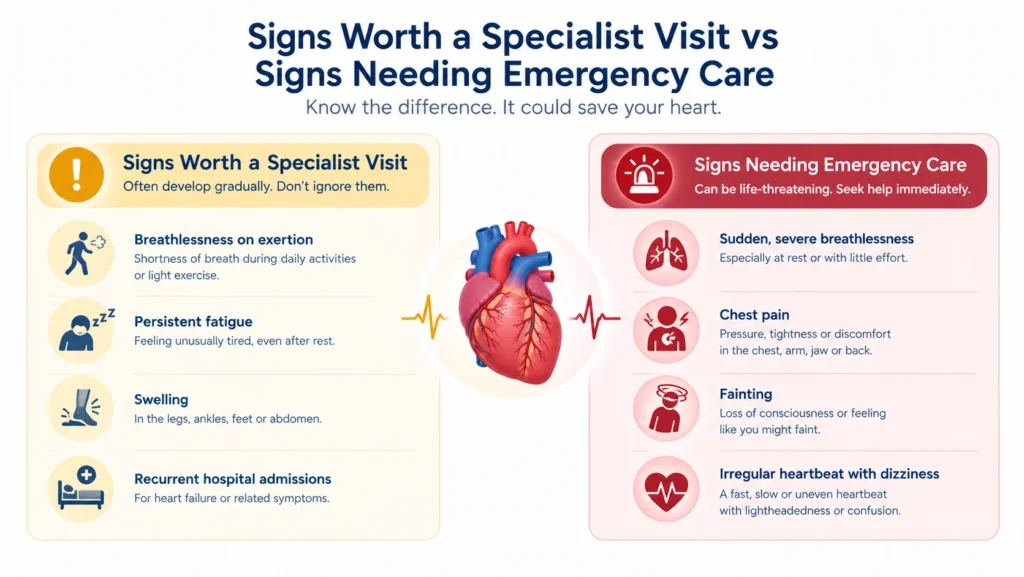
If several of these are present and worsening, it is reasonable to ask your treating doctor about a review by an advanced heart-failure or transplant team.
What Happens Before a Heart Transplant Is Recommended?
Before transplantation is recommended, patients go through a thorough, multi-step evaluation to confirm the severity of heart failure and check whether the body can safely support a transplant.
This typically begins with a detailed medical history and physical examination, followed by cardiac imaging such as echocardiography to assess pumping function and how the valves and chambers work. Blood tests check kidney and liver function and other relevant markers. The team also assesses how the heart and lungs work together, since lung function affects surgical risk and recovery, along with functional capacity through structured testing.
Doctors also review other organ health, general fitness for major surgery, and any conditions affecting long-term outcomes, and consider whether alternative advanced therapies could be appropriate instead of, or before, transplantation. A transplant is never assumed to be the automatic next step; it is one possibility among several weighed carefully.
Is Heart Transplant Really the Only Option?
In most cases, heart transplantation is one of several options for advanced heart failure, not automatically the only one, and the right approach depends on each patient’s condition and test results.
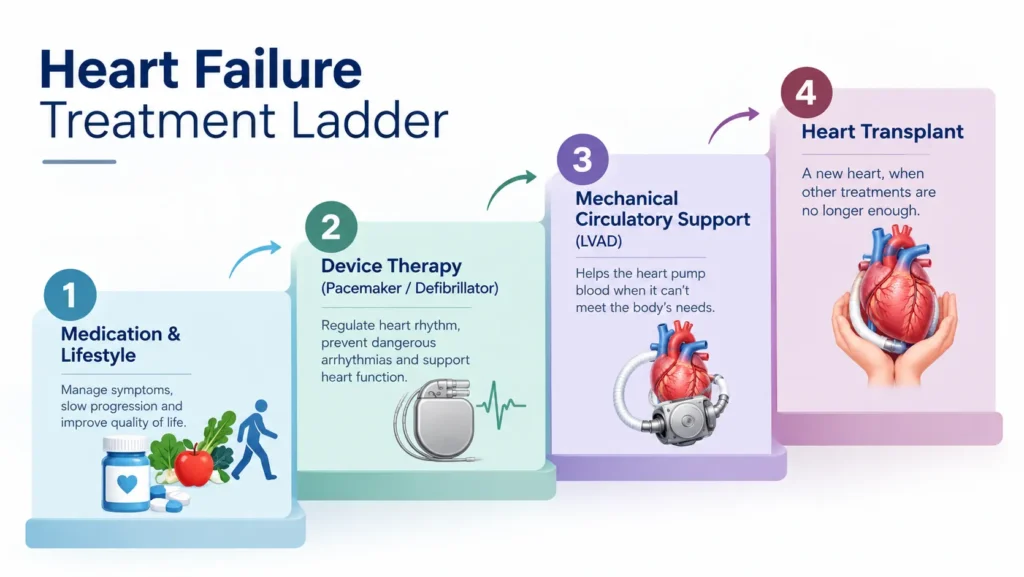
Treatment sits on a spectrum. Many patients benefit from optimised medical therapy, with doses and combinations adjusted over time, and from device-based therapies such as certain pacemakers or defibrillators.
For selected patients whose heart function has declined significantly, mechanical circulatory support devices such as a left ventricular assist device (LVAD) can help the heart pump more effectively, either as a bridge while awaiting transplant or, in some cases, as a longer-term treatment when transplantation is not suitable. Other advanced interventions may also be considered depending on individual circumstances.
Heart transplantation becomes relevant when these other options are unlikely to provide adequate benefit and a patient is assessed as a suitable candidate. This is always an individualised decision, made jointly by the specialist team and the patient’s family.
Why Early Specialist Evaluation Matters
Seeing a heart-failure specialist earlier, rather than waiting for symptoms to become severe, gives doctors more time to track disease progression and gives families more time to understand their options.
Early assessment helps track how quickly heart failure is worsening and opens up a wider range of treatments, since some advanced therapies work best when started before the heart has deteriorated too far. It also gives patients and families time to ask questions and make informed decisions together, rather than reacting under pressure during a crisis. This is not about creating alarm; it is about giving families the clearest possible picture, sooner rather than later. Consultants with dedicated experience in heart and lung transplantation and mechanical circulatory support, such as Dr Biswarup Purkayastha, are typically part of the team involved in this evaluation.
When Should You Seek Urgent Medical Attention?
Sudden or severe breathlessness, chest pain, fainting, a rapid or irregular heartbeat with dizziness, or a sudden inability to breathe while lying flat are reasons to seek emergency care immediately, rather than waiting for a scheduled appointment.
Gradual changes, such as slowly worsening tiredness or mild swelling over several weeks, generally warrant a specialist consultation rather than an emergency visit, but should not be ignored. If unsure whether a symptom is urgent, it is safer to seek immediate medical attention.
A Balanced Way Forward
Heart failure affects each person differently, and so does its treatment. A heart transplant is a significant, carefully considered option reserved for selected patients with advanced disease, arrived at only after thorough specialist evaluation. If your symptoms are worsening or no longer well controlled with current treatment, discussing this with a heart-failure or transplant specialist, such as a consultant in heart and lung transplant and vascular surgery, can help clarify the most appropriate next steps for you.
This article is for general information and does not replace personal medical consultation. Please speak to a qualified cardiologist or heart-failure specialist for advice specific to your condition.

 WhatsApp