
Silent Heart Blockages: Warning Signs, Symptoms, Diagnosis and When CABG May Be Needed
A blocked heart artery doesn’t always cause chest pain. Many people carry a significant blockage for years without realising it; it only comes to light during a routine check-up, a treadmill test, or, sometimes, after a heart attack. Doctors call this a “silent” heart blockage. Knowing the subtle warning signs, understanding when tests are needed, and knowing how doctors decide on treatment, including coronary artery bypass grafting (CABG, commonly called bypass surgery), can help you or your family seek timely care. Dr. Biswarup Purkayastha, a cardiothoracic and vascular surgeon at Artemis Hospitals, Gurugram, sees patients right across this spectrum, from those with mild, easily managed disease to complex, multi-artery blockages that need surgery.
Can You Have a Heart Blockage Without Symptoms?
Yes, you can. Heart blockages can develop quietly over the years. Some people feel occasional discomfort they brush off as gas or tiredness. Others feel nothing at all until a health check-up or a cardiac event brings it to light.
This happens because arteries usually narrow gradually, not overnight. The heart sometimes adjusts by growing tiny new blood vessels around the blockage. In people with diabetes especially, nerve changes can blunt the usual warning pain, so a serious blockage may not “hurt” the way you’d expect. Age and individual pain tolerance also play a part.
The key thing to remember: not feeling any symptoms doesn’t mean your arteries are fine. This is exactly why people with risk factors are encouraged to get checked proactively, rather than waiting to feel unwell.
Why Some Blockages Stay Silent
A few things influence whether a person feels warning signs or not:
- Nerve sensitivity varies from person to person; some people simply don’t register reduced blood flow as pain
- Gradual narrowing gives the heart time to build small alternate pathways for blood, which can delay or soften symptoms even as the blockage grows
- Diabetes can affect the nerves that would normally signal discomfort, making silent disease more common in diabetic patients
- Pain perception itself differs between individuals; the same degree of blockage can feel very different from one person to the next
None of this means the blockage is any less serious. It simply means you can’t rely on how you feel to judge how your heart arteries are doing.
Warning Signs of a Heart Blockage You Should Not Ignore
Everyone’s body gives different signals. Not every patient gets the classic “chest pain” you see in movies.
Common warning signs
- Heaviness, tightness or discomfort in the chest, especially while walking, climbing stairs, or exerting yourself
- Getting breathless doing things that never used to tire you
- Needing to slow down or stop more often during daily activities
- Feeling unusually tired for no clear reason
Less obvious symptoms
- Discomfort in the jaw, arm, shoulder or back
- A feeling like indigestion or nausea
- Sweating without any physical exertion
- Feeling light-headed or dizzy
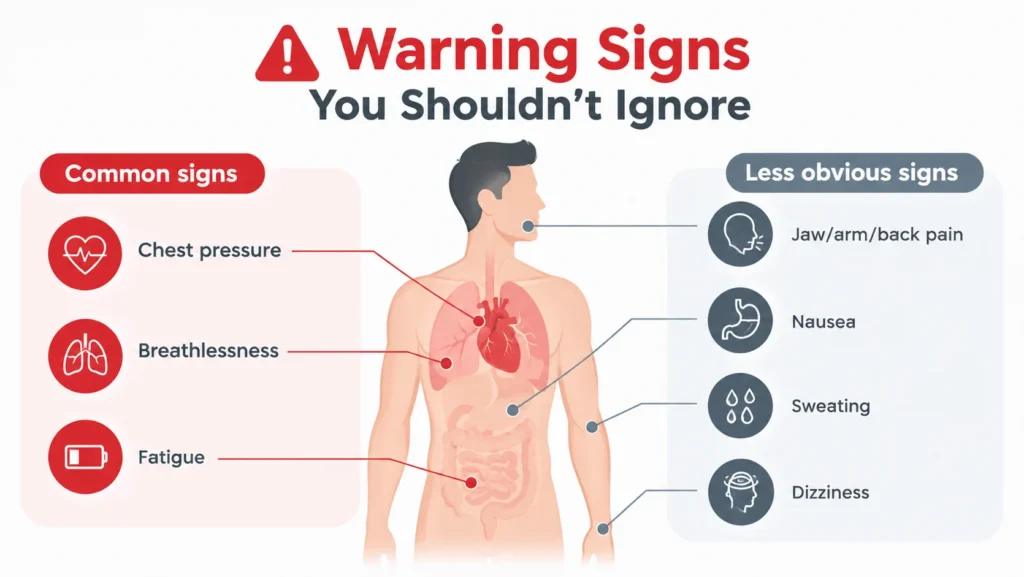
Women, older adults, and people with diabetes more often get these less obvious symptoms rather than classic chest pain, which is why the problem sometimes gets missed or mistaken for something else. If something feels different or new, even if it’s mild, it’s worth getting checked rather than waiting it out.
When Heart Blockage Symptoms Need Emergency Care
If you or a family member suddenly has severe chest pain or pressure, breathlessness, heavy sweating, nausea, fainting, or pain spreading to the arm, shoulder, jaw, back or upper abdomen, treat it as an emergency. It doesn’t matter if the symptoms started five minutes ago or have been going on for a while, or if they seem mild. Don’t wait to “see if it passes,” and don’t wait for a scheduled OPD appointment. Call for emergency help or get to the nearest emergency room immediately.
Who Is at Higher Risk of Silent Coronary Artery Disease?
Some people are more likely to develop a heart blockage that stays hidden for a long time. Risk goes up with:
- Diabetes
- High blood pressure
- High cholesterol
- Smoking
- Being overweight
- A sedentary lifestyle
- Increasing age
- A family history of heart disease
- Already having some form of heart or blood vessel disease
If you tick several of these boxes, diabetes in particular, it’s worth talking to a doctor about a heart check-up even if you feel completely fine.
Why Timely Evaluation Matters
Getting evaluated early, rather than waiting for symptoms to become obvious, generally means more treatment options are available and management tends to be simpler. When a blockage is found only after it has progressed significantly, treatment can become more complex, and the choices available may be more limited. This is why doctors encourage at-risk individuals to get assessed proactively rather than waiting to “feel” something wrong first.
How Is a Silent Heart Blockage Diagnosed?
Diagnosis is a step-by-step process: your doctor decides which tests you actually need based on your symptoms and risk factors, not every patient needs every test.
Tests commonly used include:
- ECG (electrocardiogram): A quick, painless test that records your heart’s electrical activity and can pick up signs of past or ongoing strain
- Blood tests: Including cholesterol levels and markers that indicate heart stress
- Echocardiography (echo): An ultrasound scan of the heart that checks how well it’s pumping and how the valves are working
- Stress test (TMT): Checks how your heart responds when it’s working harder, usually on a treadmill
- CT coronary angiography: A non-invasive scan that gives a detailed picture of the arteries and any blockages
- Invasive coronary angiography: A catheter-based procedure, usually done just before or during treatment planning, that gives the clearest, most detailed view of exactly where and how severe the blockage is
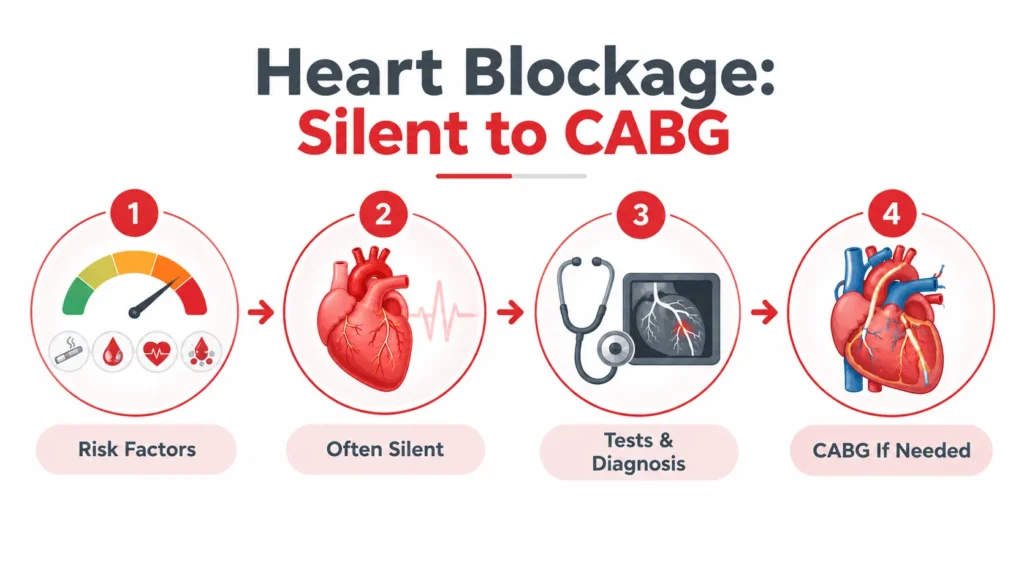
Your cardiologist or cardiac surgeon will decide the right order and combination of tests based on your specific situation.
Preventive Heart Screening for At-Risk Individuals
If you’re symptom-free but fall into a higher-risk group, your doctor may suggest routine screening rather than waiting for symptoms to appear:
- Blood pressure monitoring
- Lipid (cholesterol) profile
- Blood sugar testing
- Baseline ECG
- Further testing such as TMT or echo, if your doctor feels it’s warranted
This isn’t a checklist everyone needs; it’s a guide to what at-risk individuals are often advised to discuss with their doctor.
When Does a Heart Blockage Require CABG?
Not every blockage needs bypass surgery. CABG is generally recommended when the number, location and complexity of the blockages mean surgery is likely to work better for you, long-term, than a stent or medicines alone.
In simple words, CABG creates a new path for blood to reach your heart muscle, bypassing the blocked section of the artery. Surgeons usually use a healthy blood vessel, often an artery from inside the chest wall, or sometimes a vein from the leg, to build this new route. The old blockage stays where it is; blood simply flows around it now.
Surgery is usually favoured over a stent when:
- Multiple arteries are significantly blocked
- The left main artery, a critical artery supplying a large part of the heart, is affected
- The blockages are in an awkward location or pattern that isn’t suitable for stenting
- You have diabetes along with multiple blocked arteries, where surgery tends to hold up better over time
- Your heart’s pumping function is already reduced alongside significant blockages
Ideally, this decision isn’t made by one doctor looking at one report; it comes from a discussion between your cardiologist and cardiac surgeon together, considering your arteries, your overall health, your symptoms, and what matters to you.
CABG vs Angioplasty: How Is the Treatment Decided?
| Factor | Angioplasty (Stent) | CABG (Bypass Surgery) |
| How it’s done | Through a catheter, no cuts needed | Surgery, open or minimally invasive, using a graft |
| Usually suited for | One or two simpler blockages | Multiple, complex, or left-main artery blockages |
| Recovery | Usually quicker | Takes longer, with a structured recovery plan |
| Long term | May sometimes need repeat procedures in complex cases | Often holds up better in complex, multi-artery disease |
There’s no one “better” treatment for everyone; what’s right for your neighbour or relative may not be right for you. The final decision between stenting, bypass surgery or medicines should always come after your cardiology and cardiac surgery team has properly reviewed your specific heart and arteries.
Living With Coronary Artery Disease
Whichever treatment path is chosen, medicines, angioplasty or bypass surgery, ongoing care doesn’t stop at the procedure itself. Managing coronary artery disease over the long term usually involves a combination of:
- Medical therapy, to support blood flow and reduce future risk
- Lifestyle changes, including diet, physical activity, and quitting smoking where relevant
- Regular monitoring of heart function through follow-up visits and periodic tests
- Procedural or surgical treatment, if and when it becomes appropriate
The right combination is individualised, based on your specific condition, how you respond to treatment, and your doctor’s ongoing assessment.
How to Choose a Cardiothoracic Surgeon in Delhi NCR
Picking one of the best heart surgeon in Delhi NCR for heart surgery is a big decision for any family. A few things worth checking:
- Has the surgeon done this specific procedure before, CABG, valve surgery, aortic surgery, and how often
- Is there a proper cardiac team around them, not just one doctor working alone
- Does the hospital have good ICU and post-surgery cardiac care
- Does the surgeon explain your options clearly, in a way you actually understand
- Do they offer minimally invasive options where suitable
- Will you have clear communication and support through your recovery, not just before the surgery
If you’re looking for an experienced cardiothoracic surgeon in Gurgaon, Dr. Biswarup Purkayastha at Artemis Hospitals treats coronary, valve, aortic and transplant patients.
If you’re feeling more breathless than usual, more tired than usual, or you know you have risk factors for heart disease, get checked sooner rather than later, don’t wait for things to get worse.
Frequently Asked Question
Can you have a heart blockage without chest pain?
Yes. Many people with a significant blockage feel little or no chest pain, this is especially common in people with diabetes. Getting breathless or tired more easily can be the only clue, so any change in your stamina is worth mentioning to your doctor.
What are the early warning signs of a heart blockage?
Early signs can include chest heaviness or tightness on exertion, getting breathless doing things that didn’t tire you before, unusual fatigue, and sometimes jaw, arm or back discomfort. Everyone’s symptoms can look a little different.
Can a silent heart blockage be detected during a health check-up?
Yes. This is often how it’s found, especially in people with risk factors like diabetes, high blood pressure, or a family history of heart disease. A simple ECG, blood test, or scan during a routine check-up can pick up early signs.
When is CABG recommended for heart blockage?
CABG is usually recommended when there are multiple blocked arteries, a blockage in the left main artery, a complex blockage pattern unsuitable for a stent, or diabetes along with multi-artery disease, based on your specialist’s assessment.
Is bypass surgery necessary for every heart blockage?
No, not at all. Many blockages are managed well with medicines, lifestyle changes, or a stent. Bypass surgery is generally kept for more complex or widespread blockages.
How do doctors decide between angioplasty and CABG?
It comes down to how many arteries are blocked, where the blockages are, how complex they are, how well your heart is pumping, whether you have diabetes, and your overall health, usually decided jointly by your cardiologist and cardiac surgeon.
How can I choose a cardiothoracic surgeon in Delhi NCR?
Look at their experience with your specific procedure, whether they work with a full cardiac team, the hospital’s post-surgery care facilities, and how clearly they explain your options. How easily you can travel there for follow-ups matters too.
Does Dr. Biswarup Purkayastha treat patients from Delhi NCR?
Yes. He practises at Artemis Hospitals, Gurugram, and treats patients from across Delhi NCR for CABG, valve surgery, aortic surgery and heart/lung transplants.

 WhatsApp