
Coronary Artery Bypass Grafting (CABG) in Delhi NCR
Advanced, precision-driven CABG surgery focused on complete revascularization, faster recovery, and long-term heart health.
Book Consultation
Connect with one of the best CABG surgeons in Delhi NCR for coronary artery bypass grafting.
Coronary Artery Bypass Grafting (CABG)
Precision-driven CABG surgery combining surgical excellence, advanced technique, and a strong focus on long-term heart health.
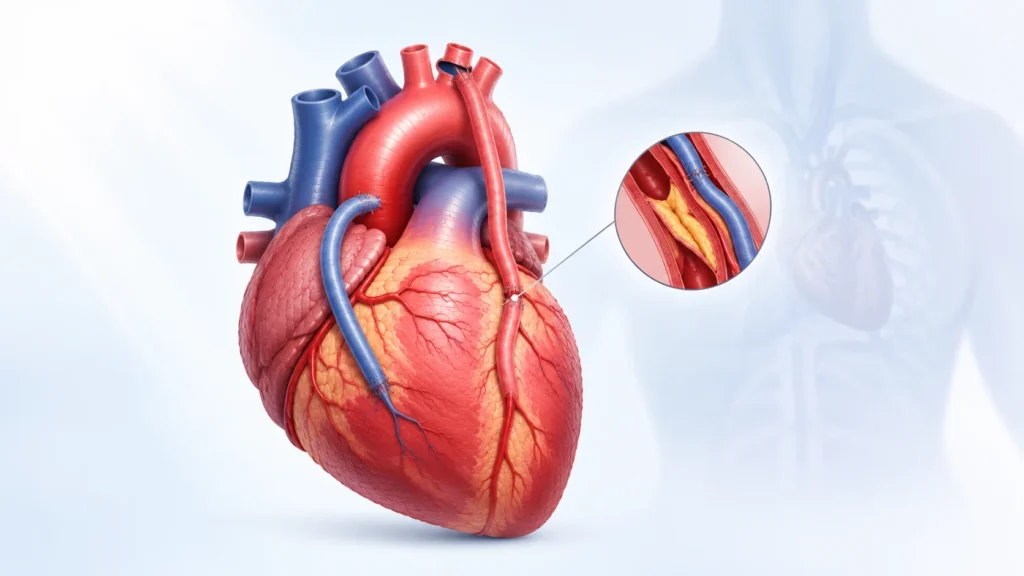
CABG (Coronary Artery Bypass Grafting) is a surgical procedure that restores blood flow to the heart by grafting a healthy blood vessel around a blocked coronary artery.
- The coronary arteries supply oxygen-rich blood to the heart muscle. When these arteries become narrowed or blocked by plaque (coronary artery disease), the heart muscle doesn't get enough blood, leading to chest pain, breathlessness, or a heart attack.
- CABG surgery treats this by using a healthy blood vessel from elsewhere in the body, commonly the internal mammary artery, a leg vein, or a forearm artery, to create a new route for blood to reach the heart, bypassing the blockage entirely.
- CABG remains the gold-standard treatment for significant coronary blockages, particularly in patients with multi-vessel disease, left main artery disease, or diabetes.
- Choosing the right coronary artery bypass surgeon matters, the graft technique, number of grafts, and surgical approach should be tailored to each patient's anatomy and risk profile.
Recognising symptoms early and consulting an experienced CABG surgeon in Delhi NCR can significantly improve outcomes and reduce the risk of a major cardiac event.

The Surgeon Behind Your Care
Dr. Biswarup Purkayastha is a cardiothoracic and vascular surgeon in Delhi NCR with 13+ years of experience performing CABG, including off-pump and total arterial grafting techniques.
Dr. Biswarup Purkayastha is one of the best heart surgeons in Gurgaon, offering comprehensive CABG surgery in Delhi NCR at Artemis Hospitals, Gurugram. His approach is built on one principle: complete, durable revascularization should never come at the cost of unnecessary surgical trauma. With the right technique, the right planning, and an individualised approach, both goals are achievable.
- 800+ CABG surgeries performed
- 100+ total arterial bypass procedures, including LIMA-RIMA grafting
- Trained internationally in advanced cardiac surgical techniques
- Experienced in both on-pump and off-pump CABG
Risk Factors for Coronary Artery Disease
Certain factors increase the risk of developing blockages that require CABG surgery
Major risk factors for coronary artery disease include diabetes, high blood pressure, high cholesterol, smoking, obesity, sedentary lifestyle, and family history of heart disease.
- Diabetes mellitus
- High blood pressure (hypertension)
- High cholesterol / dyslipidaemia
- Smoking and tobacco use
- Obesity and sedentary lifestyle
- Family history of coronary artery disease or early heart attacks
- Chronic stress
- Increasing age (risk rises after 45 in men, 55 in women)
- Prior history of radiation to the chest
Symptoms That May Indicate You Need CABG Surgery
Warning signs that may require CABG include chest pain or tightness, breathlessness, fatigue, and pain radiating to the arm, jaw, or back, especially during exertion. Early detection makes a real difference in outcomes. Speak to a heart doctor if you or a loved one experiences any of the following:
Chest pain, pressure, or tightness (angina), especially during physical activity
Breathlessness on exertion or while lying down
Pain radiating to the arm, shoulder, jaw, neck, or back
Unexplained fatigue or reduced exercise tolerance
Palpitations or irregular heartbeat
Poor response to heart failure medications
Sweating, nausea, or lightheadedness alongside chest discomfort
Swelling in the legs or ankles (in advanced cases)
How Is the Need for CABG Diagnosed?
The need for CABG is diagnosed through ECG, echocardiography, stress testing, and coronary angiography, which confirms the exact location and severity of blockages.
Clinical Examination
A thorough assessment of symptoms, cardiac risk factors, and physical signs to guide further testing.
ECG (Electrocardiogram)
Detects abnormal heart rhythms and signs of reduced blood flow.
Echocardiography
Assesses heart muscle function and valve health.
Stress Test (TMT)
Evaluates how the heart performs under physical exertion.
Coronary Angiography
The gold standard for confirming the exact location, number, and severity of coronary blockages.
CT Coronary Angiography
A non-invasive imaging option to assess coronary blockages.
Blood Tests
Including lipid profile, blood sugar, and cardiac enzyme markers.
The CABG Procedure - Step by Step
CABG surgery involves harvesting a healthy blood vessel, accessing the heart, and grafting the vessel to bypass the blocked coronary artery, restoring normal blood flow.
Anaesthesia
The patient is placed under general anaesthesia for the duration of the procedure.
Graft Harvesting
A healthy artery or vein is harvested, commonly from the chest (internal mammary artery), leg (saphenous vein), or arm (radial artery).
Accessing the Heart
The surgeon accesses the heart, either with the heart temporarily stopped and supported by a heart-lung machine (on-pump), or on a beating heart without the machine (off-pump CABG).
Grafting
The harvested vessel is attached above and below the blockage, creating a new pathway for blood flow around the diseased segment.
Multiple Grafts
Depending on the number of blocked vessels, one or more grafts may be performed in the same surgery.
Closure & Recovery
Once grafting is complete, the chest is closed and the patient is moved to intensive care for close monitoring.
Types of CABG Techniques Offered
These CABG techniques are utilised as per the requirement.
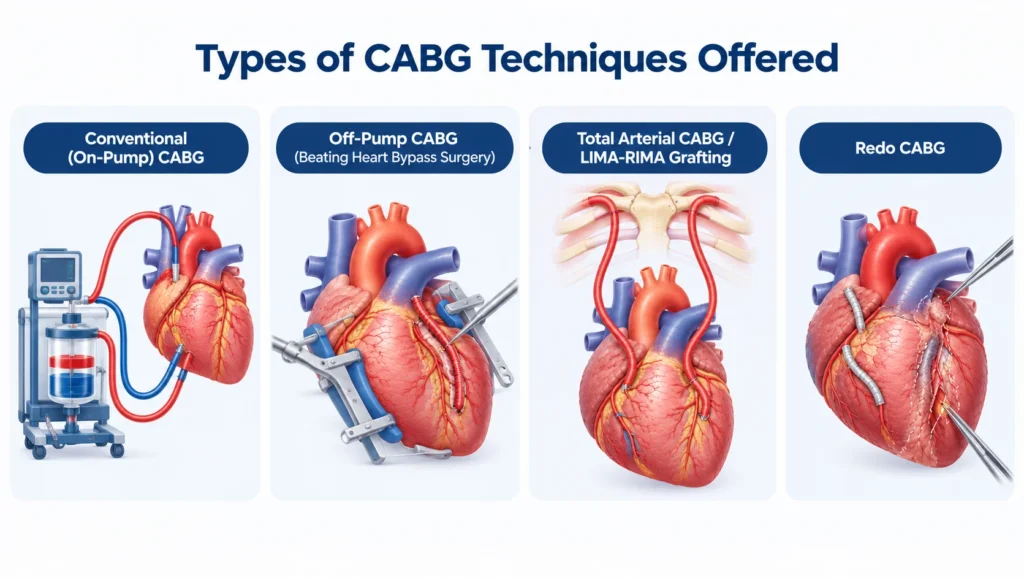
- Conventional (On-Pump) CABG - Performed with the heart temporarily stopped and a heart-lung machine maintaining circulation, allowing a still, bloodless surgical field for precise grafting.
- Off-Pump CABG (Beating Heart Bypass Surgery) - Performed without stopping the heart or using a heart-lung machine, which can reduce certain surgical risks and support faster recovery in select patients.
- Total Arterial CABG / LIMA-RIMA Grafting - Uses arterial conduits, including both internal mammary arteries, instead of vein grafts, for superior long-term graft durability.
- Redo CABG - A repeat bypass procedure for patients with failed prior grafts or new blockages, requiring specialised surgical expertise.
How CABG Outcomes Have Improved Over Time?
CABG mortality has dropped significantly over the past two decades due to advances in surgical technique, patient monitoring, and graft selection, even as patients undergoing surgery have become older and higher-risk.
- A large population-based study found that the 30-day mortality risk after CABG surgery fell from 3.1% in 1999–2000 to 2.4% in 2011–2012, even though patients undergoing surgery over that period had more coexisting health conditions on average. JACC
- This improvement reflects advances across the board, better pre-operative risk assessment, refined surgical technique (including off-pump and total arterial approaches), improved anaesthesia and ICU monitoring, and more selective, individualised graft planning.
- Longer-term data reinforces this: patients receiving total arterial grafts (such as LIMA-RIMA bypass) have shown meaningfully better long-term survival compared to those receiving vein-only grafts, reinforcing why technique selection matters as much as the decision to operate.
- For patients today, this means CABG surgery, performed by an experienced coronary artery bypass surgeon using modern technique, carries a lower risk profile and better long-term durability than it did even a decade ago.
Why Patients Choose Dr. Biswarup Purkayastha for Heart Transplant
Patients choose Dr. Biswarup Purkayastha for his internationally trained expertise in on-pump, off-pump, and total arterial CABG, and his focus on long-term graft durability.
800+ CABG surgeries performed
100+ total arterial bypass procedures
13+ years of cardiac surgery experience
Internationally trained in advanced cardiac surgical techniques (Australia, New Zealand)
Expertise in on-pump, off-pump, and total arterial CABG
Where to Consult Dr. Biswarup Purkayastha?
You can consult Dr. Biswarup Purkayastha, one of the best cardiac surgeons at Artemis Hospitals, Gurugram.
Artemis Hsopital is a leading tertiary care centre with advanced cardiac diagnostics, modern operation theatres, and comprehensive cardiac surgical services. Dr. Purkayastha, one of the best heart doctor in Gurgaon, consults and operates here regularly, offering patients across Delhi NCR access to world-class CABG surgery close to home.
Recovery After CABG Surgery
Recovery varies by patient and depends on the extent of surgery performed.
Recovery after CABG typically involves a hospital stay of 5–7 days, followed by 4–6 weeks of structured cardiac rehabilitation before returning to normal activity.
- Initial ICU monitoring followed by step-down ward care
- Cardiac rehabilitation to rebuild strength and stamina
- Wound care and post-surgical monitoring
- Dietary and lifestyle guidance to protect graft health
- Gradual return to daily activities over 4–6 weeks
- Regular follow-up evaluations and cardiac monitoring
Frequently Asked Questions
Everything you need to know before your consultation
What are the early signs that I might need CABG surgery? expand_more
Early signs may include chest pain or tightness during exertion, breathlessness, fatigue, and pain radiating to the arm or jaw. Any recurring chest discomfort should be evaluated by a specialist without delay.
Which doctor should I consult for CABG surgery in Delhi NCR? expand_more
Patients typically consult an experienced cardiothoracic and vascular surgeon with dedicated expertise in CABG, including on-pump, off-pump, and total arterial techniques.
What is the difference between CABG and angioplasty? expand_more
CABG is a surgical procedure that creates new pathways around blocked arteries using grafts, while angioplasty is a minimally invasive procedure that opens blockages using a balloon and stent. The right option depends on the number and location of blockages.
What is off-pump CABG (beating heart bypass surgery)? expand_more
Off-pump CABG is performed without stopping the heart or using a heart-lung machine, which may reduce certain surgical risks and support faster recovery in select patients.
How many grafts are needed during CABG surgery? expand_more
The number of grafts depends on how many coronary arteries are blocked. Some patients require a single graft, while others with multi-vessel disease may need three or more.
How long does recovery take after CABG surgery? expand_more
Most patients spend 5–7 days in hospital, followed by 4–6 weeks of structured recovery and cardiac rehabilitation before resuming normal activities.
Where can I get CABG surgery in Delhi NCR? expand_more
Patients across Delhi, Gurgaon, Ghaziabad, and the wider NCR region can consult Dr. Biswarup Purkayastha at Artemis Hospitals, Gurugram, for advanced CABG surgery.
Where can I get CABG surgery in Gurgaon? expand_more
Dr. Biswarup Purkayastha performs CABG, including off-pump and total arterial bypass, at Artemis Hospitals, Gurugram.
What is the cost of CABG surgery in Delhi NCR? expand_more
The cost of CABG surgery varies based on multiple factors, including the technique used (on-pump, off-pump, or total arterial grafting), the number of grafts required, hospital stay duration, and individual patient requirements. Book a consultation with Dr. Biswarup Purkayastha for a personalised treatment plan and cost estimate.