
Aortic Disease Treatment in Delhi NCR
Aortic disease treatment depends on which part of the aorta is affected, how large or unstable it is, and whether the problem is an aneurysm, a dissection, or another acute aortic syndrome. Options range from blood pressure control and regular imaging to endovascular repair and open surgery. In Delhi NCR, Dr. Biswarup Purkayastha consults on aortic conditions at Artemis Hospitals, Gurugram.
This page explains the main conditions, warning signs, tests, and treatments so you can have a more informed conversation with your doctors. It is general information, not a personal treatment recommendation.
What Is Aortic Disease?
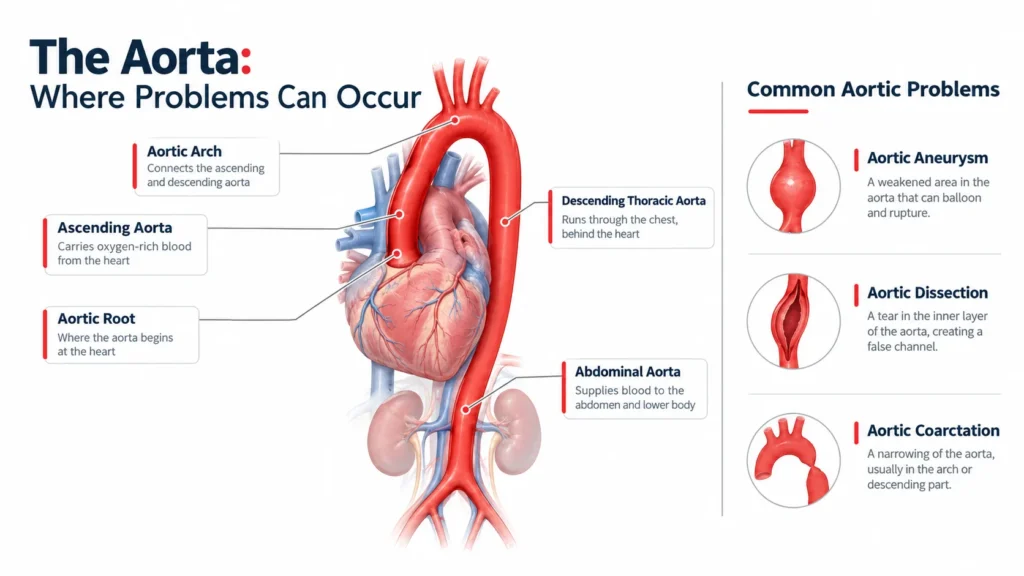
Aortic disease is any condition that weakens, widens, tears, or narrows the aorta, the body’s main artery.
The aorta carries blood from the heart to the rest of the body. It runs from the heart (root and ascending aorta), curves over the top (arch), then descends through the chest and abdomen. Different segments are affected by different diseases and treated differently.
Main Types of Aortic Disease
| Condition | What it means |
| Aortic aneurysm | A section of the aorta widens abnormally. It can occur in the chest (thoracic) or abdomen (abdominal) |
| Aortic dissection | The inner wall tears and blood flows between the wall layers. This is a medical emergency |
| Intramural haematoma / penetrating ulcer | Related conditions that, with dissection, are called acute aortic syndromes |
| Aortic root disease | Widening at the base of the aorta, often linked with the aortic valve |
| Genetic aortic conditions | Conditions such as Marfan syndrome that weaken the aortic wall |
Symptoms and When to Seek Emergency Care
Many aneurysms cause no symptoms and are found on scans done for other reasons.
Call 112 or go to the nearest emergency department immediately for:
- Sudden, severe chest, back or abdominal pain, often described as tearing or ripping
- Fainting, with or without chest or back pain
- Sudden weakness, difficulty speaking or vision loss with chest or back pain
- Sudden breathlessness with severe pain
Book a specialist review for:
- A known aneurysm on a scan, or a family history of aortic disease
- Persistent hoarseness, difficulty swallowing or a pulsing sensation in the abdomen (these can have many other causes)
Reach Out for Expert Care
Causes and Risk Factors
Causes and Risk factors for aortic disease include:
- High blood pressure
- Smoking
- Atherosclerosis (fatty plaque in the arteries) and increasing age
- A bicuspid (two-leaflet) aortic valve
- Inherited conditions such as Marfan, Loeys-Dietz or vascular Ehlers-Danlos syndrome
- Large-vessel inflammation (for example, Takayasu arteritis)
- Chest injury, or certain stimulant drugs
Family members of people with certain aortic conditions may be advised to have screening.
How Is Aortic Disease Diagnosed?
CT angiography is commonly used to confirm and measure aortic disease, with echocardiography and MRI used in selected situations.
- Echocardiogram: checks the aortic root, ascending aorta, and valve
- CT angiography: shows the whole aorta in detail, and is key in emergencies
- MRI angiography: an option for repeated follow-up without radiation
- Genetic and family assessment: where an inherited cause is suspected
Treatment Options for Aortic Disease
The right treatment depends on the location, size, growth rate, symptoms, and your overall health.
| Approach | Typically considered when | Key points |
| Medical therapy and surveillance | Smaller aneurysms; some uncomplicated dissections | Blood pressure control, stopping smoking, regular imaging |
| Endovascular repair (EVAR/TEVAR) | Suitable anatomy in the abdominal or descending thoracic aorta | A stent-graft is placed through the groin arteries. Smaller incisions, but lifelong imaging follow-up is needed |
| Open surgery | Root, ascending aorta or arch disease; anatomy unsuitable for stenting | The diseased segment is replaced with a graft. Procedures include ascending aortic replacement, Bentall procedure (aortic root and valve), valve-sparing root replacement, and arch repair |
No single approach is “better” for everyone. Each has different benefits, risks, and long-term follow-up needs.
When Is Surgery Considered?
Surgery is usually considered when the risk of rupture or dissection is judged to outweigh the risk of the operation.
- Ascending aortic aneurysm: the 2024 European guidelines recommend surgery at a maximum diameter of 55 mm or more. In people with a bicuspid aortic valve, surgery may be considered from 45 mm.
- Symptoms, rapid growth, or genetic conditions can lower the threshold.
- Acute dissection or rupture needs emergency treatment.
These are guideline reference points, not personal advice. Your surgeon will consider your age, body size, anatomy, and other health conditions.
Reach Out for Expert Care
Aortic Dissection: Why Timing Matters
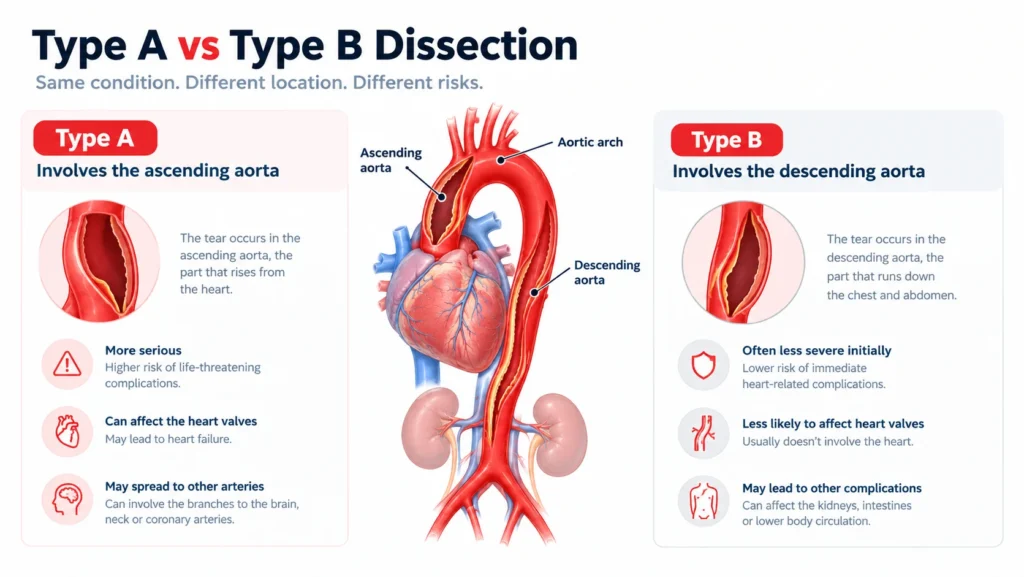
Aortic dissection needs emergency assessment because the tear can reduce blood flow to vital organs or rupture.
- Type A (involves the ascending aorta): usually treated with emergency open surgery. Guidelines suggest that a stable patient may be considered for transfer to a high-volume aortic centre.
- Type B (descending aorta only): often managed with intensive medical therapy. Endovascular repair is used when complications develop, such as organ or limb malperfusion or rupture risk.
For more detail, see Aortic Dissection Repair
Risks and Limitations of Treatment
Every aortic treatment carries risk. Depending on the procedure, these can include bleeding, infection, stroke, kidney injury, spinal cord injury (more relevant in descending and thoracoabdominal repair), irregular heart rhythm, graft or stent-graft problems needing re-intervention, and, rarely, death. Your surgeon should explain your own estimated risks and the alternatives before you decide.
Recovery and Follow-Up
- Open surgery usually involves ICU care first, then ward care and a period of structured rehabilitation. Endovascular repair often has a shorter stay.
- Recovery time varies widely. Your team will give you a plan based on your procedure and health.
- Lifelong follow-up imaging is needed after both open and endovascular repair.
- Blood pressure control and not smoking remain essential.
Cost of Aortic Disease Treatment in Delhi NCR
The cost of aortic disease treatment varies from patient to patient, depending on the condition, the type of procedure, the hospital stay and any complications. A routine scan and consultation costs far less than an endovascular or open operation, so a single figure would be misleading.
What affects the cost
- Condition and urgency: planned repair or emergency treatment
- Type of treatment: monitoring, endovascular repair (EVAR/TEVAR) or open surgery
- Graft or stent-graft: the device used and how complex the repair is
- Hospital stay: room category, ICU days and total length of stay
- Tests: CT or MRI angiography, echocardiography and blood tests
- Complications or additional procedures: such as a valve replacement alongside root repair
- Follow-up: lifelong imaging and medicines
- Insurance or cashless cover: what your policy includes
How to Choose Where to Be Treated
Aortic care works best when delivered by an experienced, multidisciplinary team. Patient searching for a top heart surgeon near me should ask these questions:
- Is there a multidisciplinary aortic team?
- Are both open and endovascular options available?
- Is emergency imaging and 24-hour ICU support available?
- How will my treatment options and risks be explained?
- What follow-up imaging will I need?
Consulting Dr. Biswarup Purkayastha at Artemis Hospitals, Gurugram
Dr. Biswarup Purkayastha, cardiac surgeon in Gurugram, is Consultant – Heart & Lung Transplant and Vascular Surgery at Artemis Hospitals, Sector 51, Gurugram. He completed an advanced fellowship in adult cardiothoracic surgery and heart-lung transplantation at Auckland City Hospital and has over 13 years of surgical practice. His practice includes aortic procedures such as aneurysm and dissection repair, Bentall procedure and ascending aortic replacement.
Consultations: Monday–Saturday, 9:00 AM–6:00 PM. Bring your CT/MRI/echo reports and images, and your medication list. Second opinions are available.
You may book an appointment at +91 8334815300
This page is general education and not a substitute for individual medical advice. Outcomes vary, and no treatment is risk-free.
Frequently Asked Questions
Q1. What is the main treatment for aortic aneurysm?
Ans. It depends on size, location, and growth. Small aneurysms are often monitored with blood pressure control and scans. Larger or fast-growing ones may need endovascular or open repair.
Q2. Can aortic disease be treated without open surgery?
Ans. Sometimes. Endovascular repair (EVAR or TEVAR) suits some abdominal and descending thoracic problems with suitable anatomy. Root, ascending and arch disease more often needs open surgery.
Q3. What are the warning signs of aortic dissection?
Ans. Sudden severe chest or back pain (often tearing), fainting, or new weakness or speech trouble. Call 112 immediately.
Q4. At what size does an aortic aneurysm need surgery?
Ans. Guidelines use size thresholds, for example 55 mm for ascending aortic aneurysms, with lower thresholds in som/e situations. Your surgeon will individualise this.
Q5. What is the Bentall procedure?
Ans. An operation that replaces the aortic root, aortic valve, and part of the ascending aorta, with the coronary arteries reattached to the graft. Valve-sparing root replacement is an alternative in selected patients at experienced centres.
Q6. How long is recovery after aortic surgery?
Ans. It varies by procedure and health. Expect ICU and hospital care followed by gradual rehabilitation, and lifelong follow-up scans.
Q7. How much does aortic disease treatment cost in Delhi NCR?
Ans. Costs vary based on multiple factors: the condition and procedure (monitoring, endovascular or open surgery), the graft or stent-graft used, room category, ICU stay, tests, any complications, and insurance. For an estimate, contact the hospital’s billing team after your consultation.
Q8. Do family members need screening?
Ans. Sometimes, especially with a genetic condition, a bicuspid valve or a family history. Ask your doctor.
Q9. Aorta ki bimari ka ilaj kya hai?
Ans. Ilaj aorta ke affected hisse, size aur aapki sehat par depend karta hai. Chhote aneurysm mein BP control aur regular scan, suitable cases mein EVAR/TEVAR stent, aur root, ascending aorta ya arch ki bimari mein aksar open surgery hoti hai.
Q10. Aortic aneurysm ka operation kab zaroori hota hai?
Ans. Jab fatne ya dissection ka khatra operation ke khatre se zyada ho. Size, badhne ki speed, symptoms aur bicuspid valve jaise factors dekhe jaate hain. Ascending aorta mein guidelines aam taur par 55 mm ya usse zyada par surgery recommend karti hain.
Q11. Dil ki badi nas ka ilaj kya hai?
Ans. Dil ki badi nas aorta hai. Kuch cases mein ilaj bina open surgery ke ho sakta hai, jaise EVAR/TEVAR ya sirf monitoring. Achanak tez seene ya peeth ka dard ho to turant 112 par call karein.
Q12. Cardiac surgeon vs cardiologist: what is the difference?
Ans. A cardiologist diagnoses and treats heart conditions with tests, medicines and procedures like angioplasty. A cardiac surgeon performs operations such as bypass, valve and aortic surgery.
Q13. How to choose a heart surgeon?
Ans. Check qualifications, registration and experience with your procedure, plus the hospital’s heart team and ICU support. A good surgeon explains risks and alternatives and never promises guaranteed results.
Q14. Can I get a second opinion for heart surgery in Delhi NCR?
Yes. it is a routine step before major surgery. Bring your reports, scans and medication list to a consultation at Artemis Hospitals, Gurugram.
Q15. What questions should I ask a heart surgeon before surgery?
Ans. Ask why surgery is needed, what the alternatives are, what the risks are in your case, and what recovery and follow-up will involve.
Q16. Open heart surgery vs minimally invasive surgery?
Ans. Open surgery uses a larger incision through the breastbone. Minimally invasive surgery uses smaller incisions and may mean a quicker recovery, but it isn’t suitable for everyone. Your surgeon will advise you on which option is safer for you.

Dr. Biswarup Purkayastha's Medical Content Team
Dr. Biswarup Purkayastha's Medical Content Team is committed to providing accurate, reliable, and easy-to-understand information on heart and lung health. Working closely with cardiothoracic and transplant specialists, the team ensures that every article is medically reviewed, up-to-date, and designed to help patients and their families better understand heart and lung conditions, treatment options, transplant care, and recovery.
 WhatsApp