
Lung Transplant in India: Who Qualifies?
A lung transplant in India is considered when end-stage lung disease no longer responds to medicines, oxygen or other treatment. Not every patient qualifies, and the decision rests on a detailed team assessment.
This guide explains who qualifies for a lung transplant, who may not, and how the evaluation and listing process works.
What Is a Lung Transplant, and When Is It Needed?
A lung transplant replaces one or both diseased lungs with healthy donor lungs. It is considered for end-stage lung disease when other treatments have failed and survival or quality of life is severely limited.
Transplant is a last-resort option, not a first-line one. Conditions that may lead to referral:
- COPD and emphysema
- Interstitial lung disease (ILD) and idiopathic pulmonary fibrosis
- Cystic fibrosis and bronchiectasis
- Pulmonary arterial hypertension
- Selected post-infection lung damage
Early referral to a lung transplant surgeon in Delhi NCR or another transplant centre matters. The ISHLT advises referring before a patient becomes too frail to be listed.
Who Qualifies for a Lung Transplant?
Lung transplant eligibility depends on advanced lung disease, a poor outlook without surgery, good enough health in other organs, and the ability to follow lifelong care. Each centre’s team makes the final decision.
In general, a candidate:
- Has progressive lung disease despite best medical treatment
- Is likely to benefit from the transplant
- Is free of serious uncontrolled infection or other organ failure
- Has stable nutrition, mobility and mental health
- Has a reliable caregiver and support system
- Is committed to medicines, follow-ups and rehabilitation
The 2021 ISHLT consensus removed many older “absolute” exclusions. Risk factors are now weighed together, so lung transplant eligibility is assessed case by case.
Is There an Age Limit for Lung Transplant in India?
There is no single fixed age limit for lung transplant in India. Biological fitness matters more than the number, though older age adds risk and is weighed with other factors.
Older patients are being listed more often. Frailty, heart function and other illnesses usually matter more than age alone.
Who May Not Qualify for a Lung Transplant?
Patients may not qualify if they have uncontrolled infection, active cancer outside the lung, severe failure of another organ, ongoing smoking or substance use, or cannot follow treatment. Some factors can be corrected before listing.
Situations that raise concern:
- Active, untreatable infection
- Recent or high-risk cancer
- Serious heart, liver or kidney disease not treatable alongside the transplant
- Current smoking, vaping or substance use
- Very poor nutrition, or severe obesity
- Repeated missed treatment or no caregiver
Many of these can be improved. A transplant team often helps patients stop smoking, build strength through pulmonary rehabilitation, or improve nutrition before listing.
Can a Lung Cancer Patient Get a Lung Transplant?
A lung transplant is not a standard treatment for lung cancer. It is considered only in rare, carefully selected cases, usually when cancer risk is very low and a separate end-stage lung disease exists.
Most lung cancers are treated with surgery, radiotherapy, targeted therapy, immunotherapy or chemotherapy. Transplant patients take lifelong immunosuppression, which can allow cancer to return. For this reason, any cancer history is reviewed very carefully.
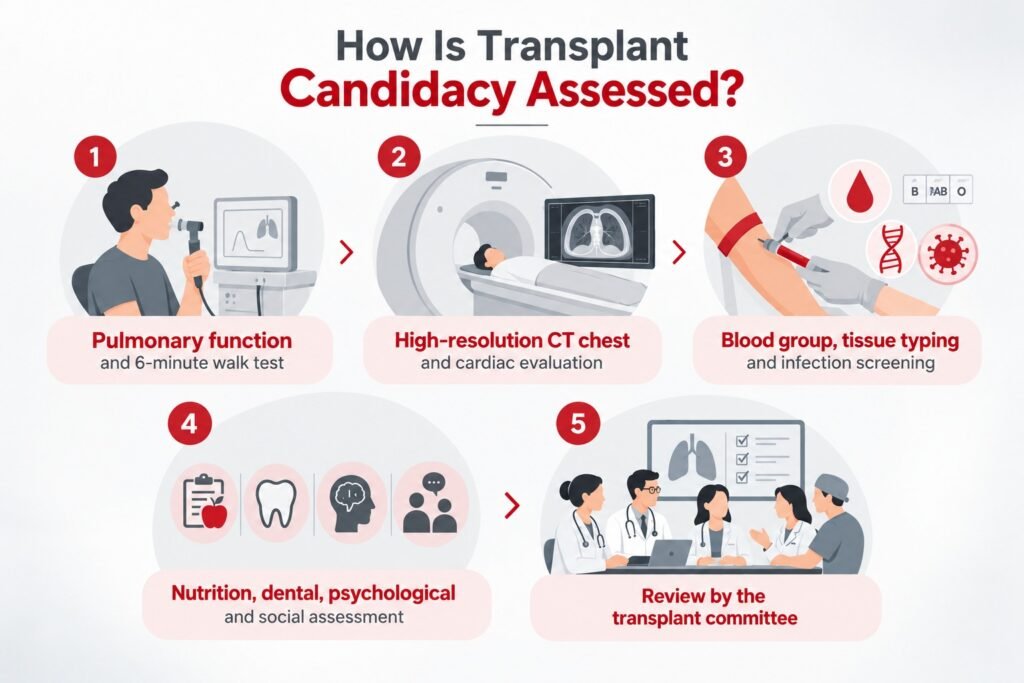
How Is Transplant Candidacy Assessed?
Candidacy is assessed through lung function tests, CT scans, heart and blood tests, infection screening, nutrition and fitness checks, and counselling by a multidisciplinary transplant team.
Typical steps:
- Pulmonary function and 6-minute walk test
- High-resolution CT chest and cardiac evaluation
- Blood group, tissue typing and infection screening
- Nutrition, dental, psychological and social assessment
- Review by the transplant committee
How Does the Lung Transplant Process Work in India?
In India, deceased-donor transplants follow the Transplantation of Human Organs and Tissues Act, 1994. Patients are registered, assessed and listed, and organs are allocated through state and national networks under NOTTO.
- Deceased-donor organs come from brainstem-dead donors under the Act.
- A NOTTO ID is mandatory for deceased-donor allocation.
- Organs go to foreign nationals only when no matching Indian patient is available.
- Organ supply is limited. Fewer than 200 lung transplants are reported yearly across India.
This is why timely referral to an experienced lung transplant centre in Delhi NCR matters.
What to Expect After a Lung Transplant
After a lung transplant, patients recover in intensive care, then the ward, followed by rehabilitation. Lifelong immunosuppressants, regular follow-ups and infection precautions are essential.
- Anti-rejection medicines for life
- Regular lung function tests and bronchoscopies as advised
- Infection prevention and vaccinations
- Rehabilitation and a healthy lifestyle
Take the Next Step
If you or a family member has advanced lung disease, an early assessment improves your options. Book a consultation with Dr. Biswarup Purkayastha at Artemis Hospitals Gurugram.
Frequently Asked Questions
Q1.Who is eligible for a lung transplant in India?
Ans. Adults with end-stage lung disease who have not responded to treatment, and have no major barriers such as active infection or uncontrolled illness in other organs, may be eligible after team evaluation.
Q2. What is the age limit for a lung transplant in India?
Ans. There is no fixed age cut-off. Overall fitness is judged along with age.
Q3. Can a lung cancer patient get a lung transplant in India?
Ans. Only in rare, carefully selected cases. Standard lung cancer treatment is usually surgery, radiotherapy or drug therapy.
Q4. How do I get on the lung transplant waiting list in India?
Ans. You need a referral to a registered transplant centre, a full evaluation, and acceptance by the transplant committee, followed by registration and a NOTTO ID.
Q5. Can foreigners get a lung transplant in India?
Ans. Yes, but under Indian law, deceased-donor organs go to foreign nationals only when no matching Indian patient is available.
Q6. What is the lung transplant cost in India for international patients?
Ans. The cost varies based on multiple factors, such as the type of transplant, hospital stay, complications, medicines and follow-up care.
Q7. How long is the lung transplant waiting time in India?
Ans. Waiting time varies with blood group, body size, urgency and organ availability. Donor supply is limited.
Q8. Who is the best lung transplant surgeon in Delhi NCR?
Ans. Choose a surgeon with specific transplant training, a multidisciplinary team, and a hospital registered for transplantation. Dr. Biswarup Purkayastha, Consultant, Heart & Lung Transplant and Vascular Surgery at Artemis Hospitals Gurugram, trained in heart and lung transplantation internationally.
References
- Leard LE, Holm AM, Valapour M, et al. Consensus document for the selection of lung transplant candidates: an update from the International Society for Heart and Lung Transplantation. J Heart Lung Transplant. 2021;40(11):1349-1379. doi:10.1016/j.healun.2021.07.005
- Government of India. Transplantation of Human Organs and Tissues Act, 1994 (amended 2011) and Rules, 2014; National Organ Transplant Programme. Ministry of Health and Family Welfare.
- NOTTO (National Organ and Tissue Transplant Organisation). Annual Report 2023-24; NOTTO-ID directive, May 2024. notto.mohfw.gov.in
- Review of thoracic organ transplantation in India. IMA Journal / Kauvery Hospital (kauveryhospital.com/ima-journal).

 WhatsApp