
Bentall Procedure and Aortic Root Replacement in Delhi NCR
People searching for the Bentall procedure in Delhi NCR are usually facing a new scan result or advice that the aortic root needs attention. This page explains the operation in plain language: what it replaces, why the coronary arteries are reattached, when it may be considered, and what the risks, recovery and follow-up involve.
Quick summary: The Bentall procedure is open-heart surgery that replaces the aortic valve, the aortic root and the first part of the ascending aorta with a single valved graft. The coronary arteries are reattached to the graft. It is considered when the root and valve are both diseased, for example with an aortic root aneurysm and valve leakage.
Not every enlarged aortic root needs this operation. The right choice depends on the valve, the size and shape of the aorta, the cause, and the patient’s overall health.
What Is the Bentall Procedure?
The Bentall procedure replaces the aortic valve, the aortic root and the start of the ascending aorta with one composite valved graft, then reconnects the coronary arteries to it.
A simple look at the anatomy makes the operation easier to follow.
-
Aortic root: the base of the aorta where it leaves the heart. It holds the aortic valve and three small bulges called the sinuses of Valsalva.
-
Aortic valve: a valve that keeps blood flowing one way, from the heart into the aorta.
-
Coronary arteries: two arteries that start at the root and feed the heart muscle.
-
Ascending aorta: the section above the root that rises towards the arch.
-
Composite graft: a fabric tube with a valve built into one end. The valve may be mechanical or biological.
-
In surgery, the diseased root and valve are removed, the graft is sewn in, and the coronary arteries are attached to openings made in the graft.
-
The operation is named after Hugh Bentall and Antony De Bono, who described it in 1968.
When Is a Bentall Procedure Required?
A Bentall procedure may be considered when the aortic root is enlarged or damaged and the aortic valve also needs replacement. Suitability and timing are decided case by case.
Situations where doctors may consider it include:
-
Aortic root aneurysm with a leaking (regurgitant) or narrowed aortic valve
-
Root enlargement linked to a connective tissue disorder such as Marfan syndrome, when the valve cannot be preserved
-
Bicuspid aortic valve with a dilated root
-
Acute type A aortic dissection that damages the root or valve beyond repair
-
Infection or earlier surgery that has damaged the root and valve
-
Size is only one factor. Guidelines use different diameter thresholds by cause, roughly 4.5 to 5.5 cm. They also weigh growth rate, symptoms, valve function, family history, body size, and surgical risk.
-
These figures guide specialists. They are not cut-offs to apply to your own report.
Reach Out for Expert Care
Conditions That May Lead to Aortic Root Replacement
Aortic root aneurysm, root dilation, aortic valve disease, aortic dissection, and connective tissue disorders can all involve the root. None automatically needs a Bentall procedure.
How they relate:
-
Root dilation: the root is wider than expected. Many people are monitored with imaging, blood pressure control and medicines.
-
Root aneurysm: a larger, lasting bulge. It often causes no symptoms but raises the long-term risk of dissection or rupture.
-
Aortic valve disease: a root that widens can stretch the valve and cause leakage. A bicuspid valve often comes with a dilated root.
-
Aortic dissection: a tear in the inner wall of the aorta. Type A involves the ascending aorta and is an emergency. Read more on aortic dissection repair.
-
Connective tissue and inherited conditions: Marfan syndrome, Loeys-Dietz syndrome and familial aortic disease can lower the size at which surgery is advised. Close relatives may need screening.
-
For the wider picture, read the overview of aortic disease treatment and aortic aneurysm surgery.
Bentall Procedure vs Other Aortic Root Surgeries
The Bentall procedure replaces the root, valve, and ascending aorta. Ascending aorta replacement changes only the tube above the root. Valve-sparing root replacement replaces the root but keeps the patient’s own valve.
The table shows how the three differ.
|
Bentall procedure |
Ascending aorta replacement |
Valve-sparing root replacement |
|
|
Structures replaced |
Aortic valve, root, ascending aorta |
Ascending aorta only |
Aortic root and usually the ascending aorta |
|
Native aortic valve kept? |
No |
Yes (a diseased valve may be treated separately) |
Yes |
|
Valved conduit used? |
Yes |
No, a straight tube graft |
No, a graft without a valve |
|
Coronary reimplantation? |
Yes |
No, the root is left in place |
Yes |
|
May be considered when |
Root and valve are both diseased, or the root is badly damaged |
Aneurysm is limited to the ascending aorta and the root is normal |
Root is enlarged, but the valve is healthy enough to preserve |
|
Blood thinner for the valve |
Lifelong with a mechanical valve; usually not with a biological valve |
Not for the graft itself |
Usually none for the valve |
No option is better for everyone. Valve-sparing surgery depends on healthy, repairable leaflets and specific surgical experience, so it is not suitable for every patient.
Types of Bentall Procedure
A Bentall procedure uses either a mechanical or a biological valved conduit. Mechanical valves last longest but need lifelong blood thinners; biological valves usually avoid long-term warfarin but may wear out sooner.
The choice is shared between patient and surgeon.
-
Mechanical conduit: durable. It needs lifelong warfarin-type medicine with regular INR blood tests. Bleeding and clot risks need attention.
-
Biological conduit (“bio-Bentall”): uses animal or donor tissue. Long-term warfarin is usually not needed, but the valve may degenerate and need repeat treatment over time.
-
Factors that guide the choice: age, other illnesses, bleeding risk, pregnancy plans, ability to attend INR monitoring, and personal preference.
-
Most modern operations use the “button” technique, where each coronary opening is detached with a rim of aorta and sewn to the graft.
-
Both types need lifelong follow-up. No single valve is right for all patients.
How Is the Bentall Procedure Performed?
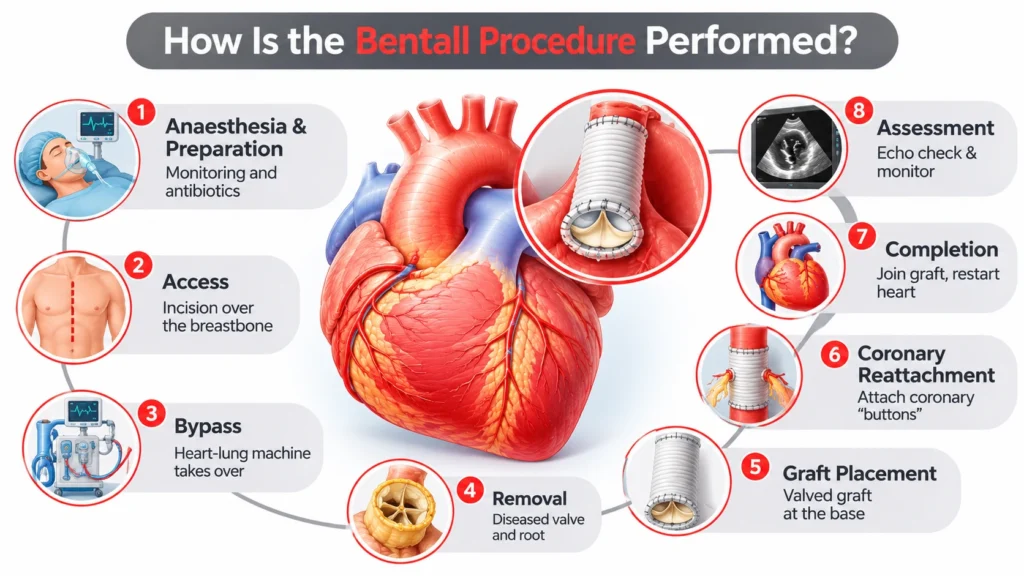
Bentall surgery is open-heart surgery under general anaesthesia. The surgeon replaces the diseased root and valve with a valved graft and reattaches the coronary arteries. Steps vary by patient and surgical plan.
In general, the sequence is:
-
Anaesthesia and preparation: monitoring lines, antibiotics, and an echo probe to guide surgery.
-
Access: usually an incision over the breastbone. Smaller approaches are used only in selected patients.
-
Cardiopulmonary bypass: a heart-lung machine takes over circulation while the heart is protected and stopped.
-
Removal: the diseased valve and root are removed. The coronary arteries are freed with a rim of aortic wall.
-
Graft placement: the valved graft is sewn at the base of the root.
-
Coronary reattachment: each coronary “button” is attached to an opening in the graft.
-
Completion: the graft is joined to the healthy aorta above, air is removed, and the heart is restarted.
-
Assessment: an echo checks valve and graft function and the team checks for bleeding. The patient is then moved to intensive care. If the aneurysm reaches the arch, further aortic surgery may be needed. The operation takes several hours.
Tests and Evaluation Before Bentall Surgery
Doctors usually combine echocardiography, CT angiography or MRI, coronary assessment, ECG, and blood tests to measure the aorta, judge the valve, and check overall fitness.
Each test has a different role:
-
Echocardiography: valve function, root size, and heart pumping strength.
-
CT angiography: accurate aortic measurements, the whole aorta, and the position of the coronary openings.
-
MRI or MR angiography: detailed images without radiation. Useful for repeat monitoring.
-
Coronary assessment: shows whether the heart arteries have blockages that need treatment in the same operation.
-
ECG: heart rhythm and conduction.
-
Blood tests: kidney and liver function, blood counts, clotting and blood grouping.
-
Individual extras: dental review, genetic evaluation or family screening, and lung or carotid tests.
Possible Complications and Risks of Bentall Procedure
Bentall surgery is major open-heart surgery with real risks, including bleeding, infection, stroke, rhythm problems, kidney injury, and valve or graft problems. Individual risk depends on health, the aortic condition, and urgency.
Possible complications include:
-
Bleeding, sometimes needing a return to theatre
-
Infection of the wound, or of the valve and graft
-
Stroke
-
Heart rhythm problems, including a slow rhythm that may need a pacemaker
-
Kidney injury
-
Blood clots, including clot on a mechanical valve if blood thinning is inadequate
-
Valve problems: bleeding on warfarin, leakage around the valve, or wear of a biological valve
-
Graft problems: infection, weakness at suture lines, or later enlargement of the remaining aorta
-
Coronary reattachment problems: narrowing, kinking or bleeding at a button
-
Need for further intervention
-
Risk is generally higher in emergencies such as acute dissection, with other illnesses, or after earlier heart surgery. Your surgeon will discuss your own risk.
Reach Out for Expert Care
Recovery After the Bentall Procedure
After Bentall surgery, patients are monitored in intensive care, then move to a ward and recover gradually. Full recovery usually takes weeks to months and differs from person to person.
Recovery generally follows this path:
-
ICU: continuous monitoring of heart rhythm, blood pressure, drains and pain.
-
Breathing: a ventilator is used at first, then removed once the patient is stable.
-
Ward: early walking, breathing exercises and physiotherapy.
-
Wound care: keep it clean and dry, and follow the team’s breastbone precautions.
-
Medicines: pain relief, blood pressure and rhythm medicines, and aspirin or a blood thinner. INR monitoring starts before discharge for mechanical valves.
-
Follow-up: a wound check, an echo and scheduled reviews.
-
Return to routine: work, driving and lifting are guided by the surgical team. Cardiac rehabilitation may be advised.
-
Treat any timeline you read as an estimate, not a promise.
Life After a Bentall Procedure
Most people return to regular activities. Life after a Bentall procedure includes lifelong follow-up: heart and aortic imaging, blood pressure control, medicines and, for mechanical valves, INR checks.
Long-term care usually includes:
-
Regular visits and echocardiography, with CT or MRI of the remaining aorta where indicated
-
Blood pressure control and taking medicines as prescribed
-
INR monitoring and awareness of diet and drug interactions for mechanical valves
-
Dental care, and asking the team about antibiotics before dental procedures
-
Activity advice set by the team, especially for heavy lifting and contact sport
-
Warning signs needing prompt assessment: fever, wound discharge, new breathlessness, fainting, palpitations, unusual bleeding or bruising, or stroke symptoms
-
Sudden severe chest or back pain is an emergency. Go to the nearest emergency department.
Why Specialist Evaluation Matters for Aortic Root Conditions
Aortic root disease needs accurate imaging, assessment of the valve and the whole aorta, and a team that can offer more than one type of repair, so the operation fits the patient.
A careful evaluation covers:
-
Measuring the aorta consistently and comparing it with earlier scans
-
Valve function and valve shape, such as bicuspid or tricuspid
-
The full length of the aorta, not just the root
-
Family history, genetic conditions and other illnesses
-
Choosing between Bentall, valve-sparing root replacement and ascending aorta replacement
-
Coordinated follow-up after surgery
-
Questions you can ask any surgical team:
-
Do I need surgery now, or can I be monitored?
-
Why this operation rather than the alternatives?
-
Which valve do you advise, and why?
-
What is my personal risk?
-
Who manages my blood thinner and follow-up scans?
-
Should my relatives be screened?
-
About Dr. Biswarup Purkayastha Consults
Dr. Biswarup Purkayastha is a cardiothoracic and vascular surgeon who consults at Artemis Hospitals, Sector 51, Gurugram, as Consultant – Heart & Lung Transplant and Vascular Surgery.
Relevant professional details:
-
Qualifications: MBBS, DrNB in Cardiothoracic Surgery
-
Membership of the European Board of Cardiothoracic Surgery (MEBCTS), by examination
-
Greenlane Fellowship in Adult Cardiothoracic Surgery and Heart-Lung Transplantation, Auckland City Hospital
-
Member of IACTS, EACTS and ISHLT
-
Registration number: 31938
Whether a particular procedure is suitable is decided only after clinical assessment. To discuss your reports, you may book a consultation. More background is on the About Doctor page.
Frequently Asked Questions
Q1. What is the Bentall procedure?
Ans. It is an open-heart operation that replaces a diseased aortic valve, aortic root and part of the ascending aorta with one valved graft. The coronary arteries are then attached to the graft.
Q2. Why is a Bentall procedure performed?
Ans. It treats a diseased root and valve together. It aims to lower the risk of aortic rupture or dissection and to correct valve leakage or narrowing.
Q3. Is Bentall surgery the same as aortic root replacement?
Ans. Bentall surgery is one type of aortic root replacement, the type that also replaces the valve. Valve-sparing root replacement is another type that keeps the patient’s own valve.
Q4. Does Bentall surgery replace the aortic valve?
Ans. Yes. The graft has a mechanical or biological valve built in, and it replaces the native valve.
Q5. What happens to the coronary arteries during Bentall surgery?
Ans. Each is detached with a small rim of aortic wall, called a button, and sewn into an opening in the graft. The heart is protected throughout the operation.
Q6. What is the difference between a mechanical and biological Bentall procedure?
Ans. A mechanical valve is very durable but needs lifelong blood thinners. A biological valve usually avoids long-term warfarin but may wear out and need repeat treatment.
Q7. How long does recovery after Bentall surgery take?
Ans. It varies. Hospital stay is often around a week or longer, and recovery commonly takes several weeks to a few months. Your team will set milestones for you.
Q8. What are the possible risks of Bentall surgery?
Ans. They include bleeding, infection, stroke, rhythm problems, kidney injury, clots, and valve, graft or coronary reattachment problems. Your own risk depends on your health, your aortic condition and how urgent the surgery is.
Q9. Is lifelong blood-thinning medication required after a Bentall procedure?
Ans. With a mechanical valve, lifelong warfarin-type treatment is usually needed. With a biological valve it is usually not, though aspirin or a short course of blood thinner may be advised.
Q10. Can a patient live a normal life after Bentall surgery?
Ans. Most people return to everyday activities. Lifelong follow-up is needed, and some limits, such as heavy lifting or contact sport, may apply.
Q11. Does every aortic root aneurysm require surgery?
Ans. No. Many are monitored with imaging, blood pressure control and medicines. Surgery is advised based on size, growth, cause, valve function, symptoms and risk.
Q12. What follow-up is needed after a Bentall procedure?
Ans. Regular clinic reviews, echocardiography, CT or MRI of the remaining aorta when advised, blood pressure control and, for mechanical valves, INR checks. Relatives may need screening for inherited aortic disease.

Dr. Biswarup Purkayastha's Medical Content Team
Dr. Biswarup Purkayastha's Medical Content Team is committed to providing accurate, reliable, and easy-to-understand information on heart and lung health. Working closely with cardiothoracic and transplant specialists, the team ensures that every article is medically reviewed, up-to-date, and designed to help patients and their families better understand heart and lung conditions, treatment options, transplant care, and recovery.

 WhatsApp