
LVAD surgery in Delhi NCR
If your heart is too weak to pump blood on its own, an LVAD (Left Ventricular Assist Device) can help it work again. Dr. Biswarup Purkayastha performs LVAD surgery in Delhi NCR at Artemis Hospitals, Gurugram, and is a proctor-led LVAD implanter in the Delhi-NCR region, meaning he personally trains and certifies other surgeons on this procedure.
If you or a loved one has been told “the heart is failing” and medicines aren’t enough anymore, this page will help you understand what LVAD surgery is, who needs it, and what to expect.
What Is LVAD Surgery?
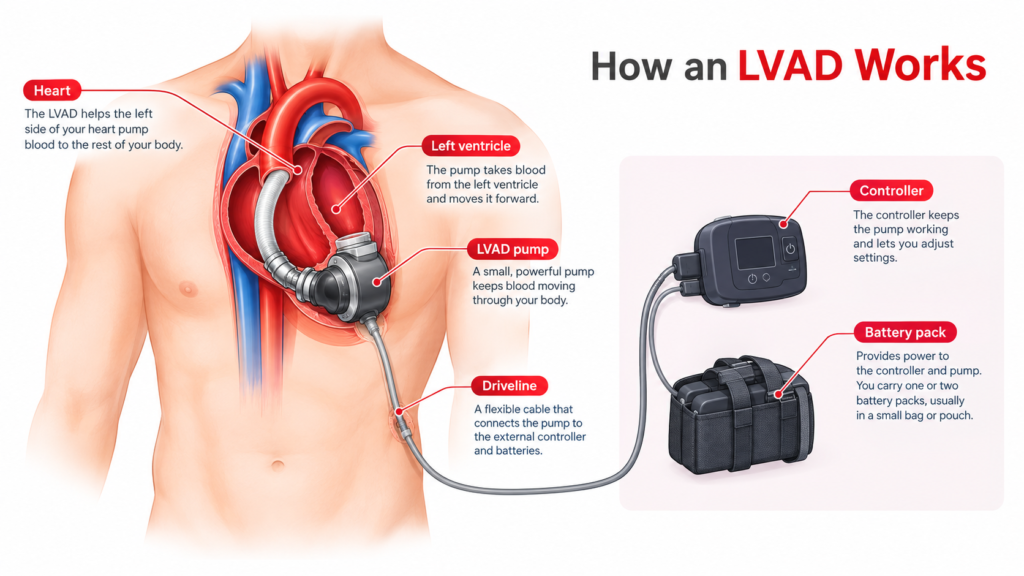
LVAD surgery is a procedure in which a mechanical pump is implanted in the chest to help a weakened heart pump blood more effectively.
- LVAD stands for Left Ventricular Assist Device, a small mechanical pump.
- It is surgically placed inside the chest to help the heart’s main pumping chamber (left ventricle) push blood to the rest of the body.
- It does not replace the heart, it supports it.
- It is one of the most advanced forms of mechanical circulatory support in Delhi for patients with severe heart failure.
Who Needs LVAD Implantation?
Patients with severe heart failure who no longer respond to medication, or who are waiting for a heart transplant, are typically considered for LVAD surgery. You may be a candidate for LVAD implantation in India if you have:
- Advanced or end-stage heart failure
- Symptoms like breathlessness, extreme fatigue, or swelling in legs, even at rest
- A heart that is not responding well to medicines anymore
- Been advised a heart transplant, but need support while waiting (bridge-to-transplant)
- A condition where transplant isn’t planned, and LVAD is the long-term solution (destination therapy)
Reach Out for Expert Care
How LVAD Surgery Works – Step by Step
LVAD surgery involves implanting a pump connected to the heart, with an external controller worn outside the body, followed by ICU monitoring and patient training.
- Evaluation: Heart function tests, blood work, and imaging to confirm you’re a suitable candidate.
- Pre-surgery planning: The team maps out the exact device size and surgical approach for you.
- Surgery: The pump is placed inside the chest, connected to the left ventricle and the main artery (aorta).
- Driveline placement: A thin cable connects the internal pump to an external controller and battery, worn outside the body.
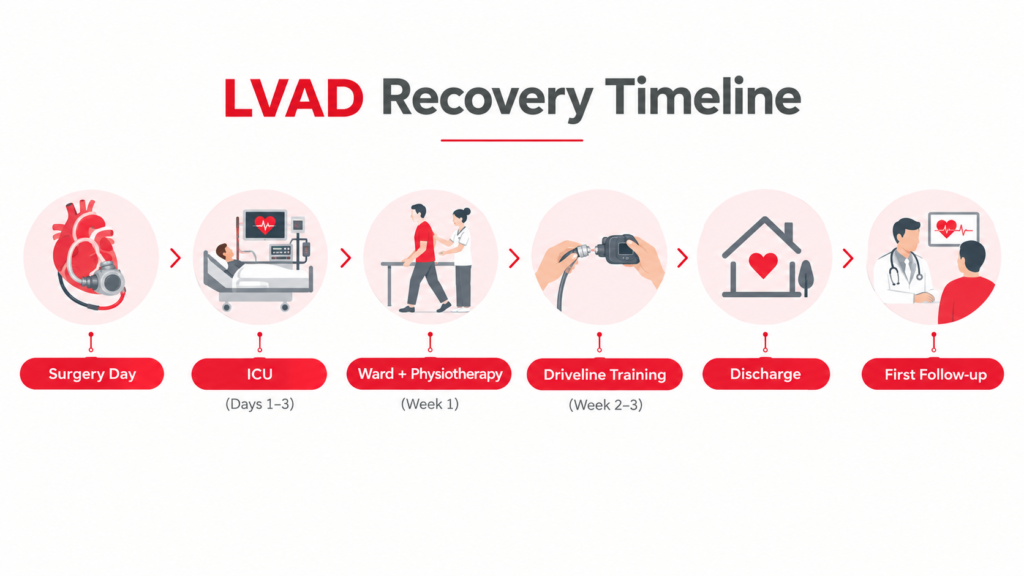
- ICU monitoring: Close observation for a few days to ensure the heart and device are working together well.
- Recovery and training: You and your family are trained to manage the device before discharge.
Benefits of LVAD Surgery
LVAD surgery improves blood flow, reduces heart failure symptoms, and can extend and improve quality of life for patients with advanced heart failure.
- Restores blood flow to vital organs
- Reduces breathlessness and fatigue
- Improves ability to carry out daily activities
- Can extend life expectancy significantly in advanced heart failure
- Buys valuable time for patients waiting for a heart transplant
- Allows many patients to return home and resume a near-normal routine
Risks and Complications
LVAD surgery risks include bleeding, infection, blood clots, and other complications. Your surgeon will explain these risks and monitor you closely through regular follow-up.
- Bleeding or infection at the driveline site
- Blood clot formation
- Device-related complications
- Right heart function needing extra support after surgery
Regular follow-up and device checks significantly reduce these risks over time.
Recovery After LVAD Surgery
Recovery after LVAD surgery usually involves a 2–3 week hospital stay, early physiotherapy, and training in driveline care before going home.
- Hospital stay: typically 2–3 weeks, depending on recovery
- ICU monitoring for the first few days
- Physiotherapy starts early to rebuild strength
- Driveline care taught to patient and family before discharge
- Regular follow-ups to monitor device function and heart recovery
- Most patients gradually return to light daily activities within weeks
Cost of LVAD Surgery in India
The cost of LVAD surgery in India depends on the LVAD device type, hospital stay, patient’s condition, and individual treatment needs. Your surgeon can provide an estimated cost after evaluating your specific case.
- Type and brand of LVAD device used
- Hospital stay duration and ICU requirements
- Pre-surgery tests and evaluations needed
- Any additional procedures required alongside LVAD
- Post-surgery care and follow-up needs
Because every patient’s condition is different, it’s best to get a personalised cost estimate after consultation. Dr. Purkayastha’s team can guide you through this during your evaluation.
What Does Recent Research Say About LVAD?
Recent LVAD research shows newer magnetically levitated devices offer improved survival, safety, and quality of life, with some younger patients seeing outcomes comparable to heart transplantation.
- Newer-generation LVADs, like fully magnetically levitated pumps, continue to show strong long-term outcomes, with five-year data now available from major trials tracking survival and complication rates over extended use.
- A 2026 analysis suggests LVADs may offer survival benefits comparable to, or in some cases better than, heart transplantation for younger heart failure patients, prompting doctors to individualise the choice between transplant and LVAD rather than defaulting to transplant.
- Newer third-generation magnetically levitated pumps have shown improved blood compatibility and safety, with 1-year survival rates around 91–92% and notably lower driveline infection rates compared to older device generations.
- A pooled analysis of destination-therapy LVAD patients found statistically significant improvements in both survival and quality of life after implantation, reinforcing LVAD as a credible long-term option, not just a “waiting room” for transplant.
- Research is also exploring myocardial recovery, a small but growing subset of patients show meaningful heart function improvement after LVAD support, occasionally allowing the device to eventually be removed.
Reach Out for Expert Care
Why Choose Dr. Biswarup Purkayastha for LVAD Surgery in Delhi?
Dr. Biswarup Purkayastha is a proctor-level LVAD surgeon in Delhi-NCR, combining transplant fellowship training with ELSO ECMO certification.
- Recognised as one of the best heart doctor in Delhi NCR, with focused expertise in advanced heart failure and mechanical circulatory support
- LVAD proctor in Delhi-NCR, trains other cardiac surgeons on this exact procedure
- ELSO-certified Adult ECMO Practitioner, trained in managing patients on advanced life-support devices
- Fellowship-trained in Heart & Lung Transplantation from Auckland City Hospital, New Zealand
- 150+ cases of ECMO, VAD, and mechanical circulatory support performed
- Widely regarded as one of the best cardiothoracic surgeon in Gurgaon, treating both heart and chest (thoracic) conditions under one roof
- Also known among patients searching for the best chest doctor in Gurgaon, given his combined cardiothoracic training
If you or a family member has been advised LVAD surgery, don’t wait. Early evaluation can make a real difference to outcomes.
You may consult Dr. Biswarup Purkayastha – Cardiothoracic & Vascular Surgeon, Heart & Lung Transplant Specialist, Artemis Hospitals, Gurugram.

Dr. Biswarup Purkayastha's Medical Content Team
Dr. Biswarup Purkayastha's Medical Content Team is committed to providing accurate, reliable, and easy-to-understand information on heart and lung health. Working closely with cardiothoracic and transplant specialists, the team ensures that every article is medically reviewed, up-to-date, and designed to help patients and their families better understand heart and lung conditions, treatment options, transplant care, and recovery.

 WhatsApp